

The conversation around Kona real estate market continues to evolve in April 2026, but the shift is not what many headlines might suggest. Rather than a downturn, what we are seeing is a transition into a more selective and strategic market environment.
After several years of rapid appreciation, limited inventory, and urgency-driven decision-making, the Kona market is now entering a phase where buyers are more deliberate and sellers must be more precise. This shift is creating a healthier and more sustainable marketplace—one where decisions are based on value, condition, and long-term fit rather than speed.
From Kailua-Kona to Captain Cook, and across Waikoloa and the Kohala Coast, understanding how this reset is playing out locally is essential for making informed real estate decisions.
A Market Shift: Not a Crash, But a Reset
The most important takeaway for Kona real estate market is that the market is not experiencing a collapse—it is recalibrating.
Recent data shows that while single-family home sales declined year-over-year, median prices still increased slightly. Condo sales also decreased, with modest downward pressure on pricing.
This combination reflects a market where demand still exists, but buyer behavior has changed significantly.
Buyers are no longer making rapid, emotion-driven decisions. Instead, they are carefully evaluating properties, comparing options, and prioritizing value over urgency. This shift marks a transition from a reactive market to one that rewards strategy and patience.
A slower pace in this context is not a sign of weakness—it is a sign of normalization. The market is moving toward a more balanced state where both buyers and sellers must operate with greater clarity and intention.
April 2026 Snapshot: Inventory Up, Pace Slower
One of the clearest indicators of change in Kona real estate market is the increase in available inventory combined with a slower rate of sales conversion.
In Kailua-Kona, recent data revealed that there were 168 single-family homes on the market, with only 25 closed sales during the same period. Condo inventory showed a similar pattern, with 171 units available but only 22 closing.
This imbalance between available listings and completed transactions explains why the market feels slower, even though demand has not disappeared.
Additional data points reinforce this trend:
- The median time for a property to go pending is now approximately 48 days, indicating that buyers are taking more time to evaluate options before committing.
- Nearly three-quarters of homes are selling below their original list price, reflecting increased negotiating power among buyers.
- The average sale-to-list price ratio has dropped below one, showing that sellers are often adjusting expectations to align with current market conditions.
Together, these factors illustrate a market where inventory is sufficient to give buyers flexibility, and where pricing and presentation play a more critical role than they did in previous years.
Kona Market: Still Strong, But Less Forgiving
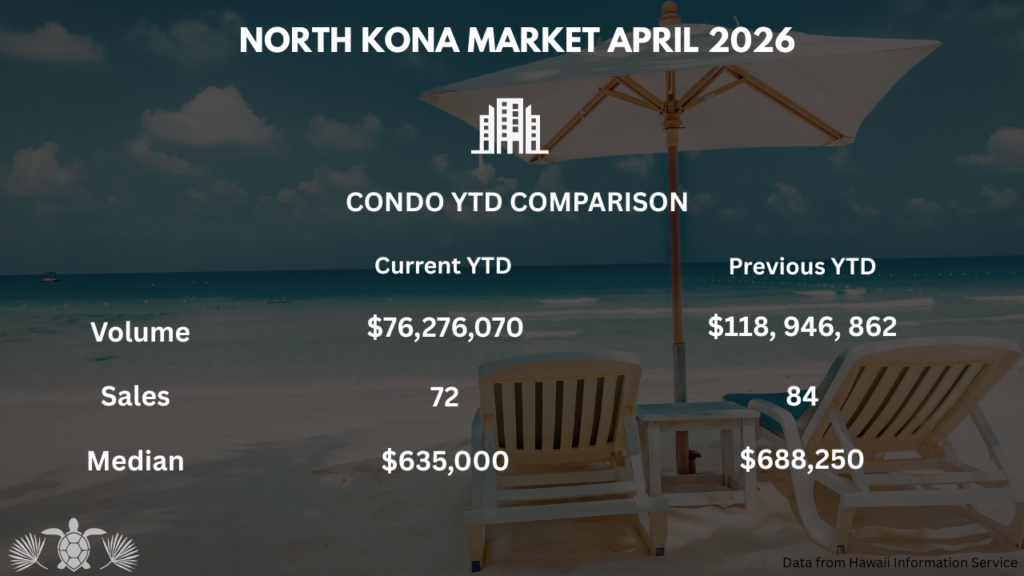
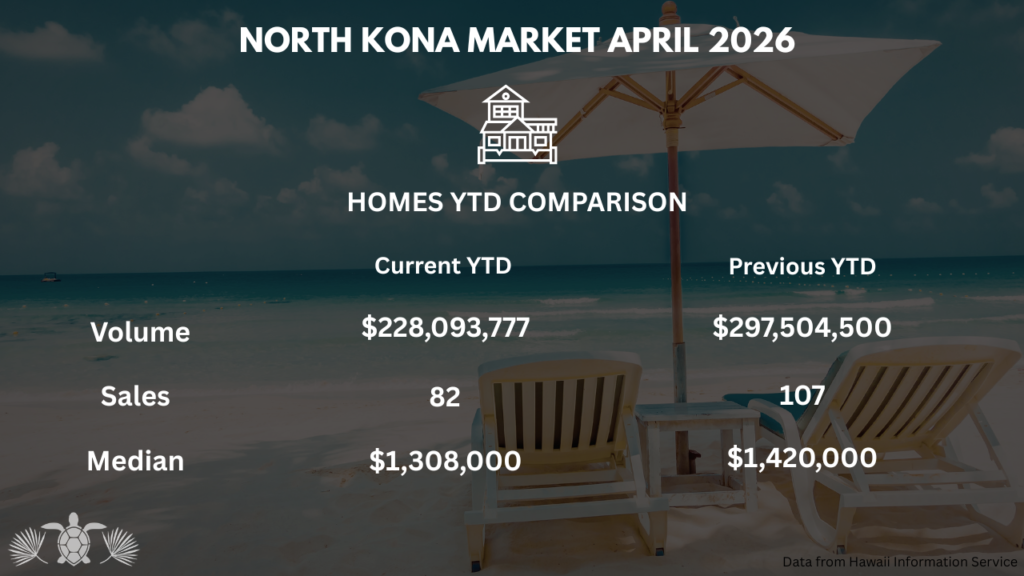
North Kona remains the most active and representative segment of Kona real estate market, but it is also where the shift toward selectivity is most visible.
Recent figures indicate that:
- The median single-family home price is approximately $1.25 million, reflecting a year-over-year decline.
- Condo prices have softened slightly, with a median around $640,000.
- Overall sales volume has decreased, signaling a slowdown in transaction activity.
However, these numbers do not suggest a weak market. Instead, they highlight a more competitive environment for sellers.
Properties that are well-priced, updated, and located in desirable areas continue to attract attention and sell. Buyers are still active, but they are prioritizing homes that offer clear value, functional layouts, and strong lifestyle appeal.
On the other hand, listings that are overpriced, poorly maintained, or lacking in key features such as usable outdoor space or favorable positioning are experiencing longer days on market and increased price reductions.
The key shift is that the market is no longer forgiving of imperfections. Sellers must now compete, and buyers have the ability to be selective.
Pricing in April 2026: Strategy Over Assumption
In today’s market, pricing has become one of the most critical factors in Kona real estate market.
Overpricing Leads to Delays
Homes priced above market expectations often:
- Sit longer on the market
- Require price reductions
- Lose momentum with buyers
Buyers Expect Value Justification
Today’s buyers are informed. They compare:
- Recent sales
- Price per square foot
- Property condition
- Location and microclimate
They expect pricing to reflect real value—not past peak trends.
Accurate Pricing from Day One
Homes that are priced correctly from the start tend to:
- Attract stronger interest
- Sell more efficiently
- Avoid extended market time
Presentation Matters More Than Ever
With more inventory available, buyers have choices. This makes:
- Professional photography
- Clean, well-maintained spaces
- Strong marketing
essential to success.
Why Real Estate in Kona Hawaii Behaves Differently
Understanding Kona real estate market requires recognizing how it differs from mainland markets.
Lower Transaction Volume
Fewer total sales mean:
- Data can shift quickly
- Individual transactions carry more weight
Strong Cash Buyer Presence
Many Kona buyers are:
- Second-home owners
- Retirees
- Investors
This reduces sensitivity to interest rate fluctuations.
Limited Seller Pressure
Unlike some mainland markets, many Kona sellers:
- Are not financially pressured to sell
- Can wait for the right offer
Limited Inventory Pipeline
Geography and zoning limit large-scale development, helping maintain long-term value.
Lifestyle-Driven Market
Kona is not just a housing market—it’s a lifestyle destination.
This influences:
- Buyer behavior
- Holding periods
- Pricing resilience
South Kona & Captain Cook: Small Market, Big Variability
The dynamics of Kona real estate market change significantly as you move into South Kona and areas like Captain Cook.
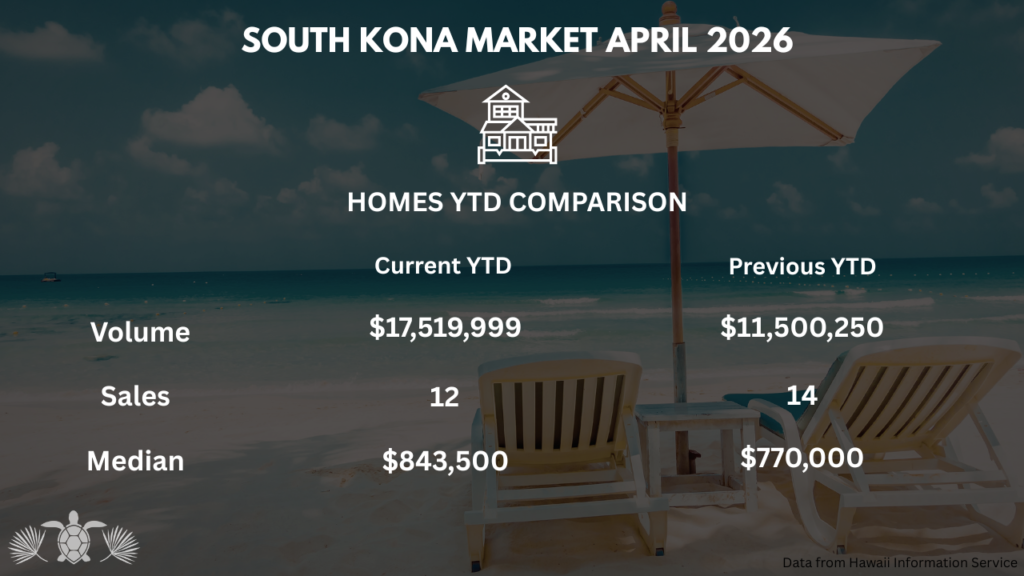
In March, the median home price in South Kona dropped to approximately $695,000, but this figure was based on only seven sales.
This low transaction volume makes it difficult to draw broad conclusions from short-term data.
Instead of relying on monthly medians, it is more useful to evaluate individual property characteristics. In South Kona, factors such as land usability, agricultural potential, water systems, privacy, and elevation often have a greater impact on value than general market trends.
For example, a well-maintained property with established agriculture and ocean views may command strong interest, while a similar-priced home with access challenges or deferred maintenance may struggle.
Waikoloa & South Kohala: Strong on Paper, Selective in Reality
South Kohala, including Waikoloa Beach Resort, shows stronger pricing metrics on the surface, but a deeper look reveals a more nuanced reality.
Recent data indicates:
- Median home prices increased to approximately $1.43 million.
- Condo prices rose significantly, driven by higher-end resort inventory.
- Sales activity increased in both segments.
While these figures suggest strength, they are heavily influenced by the type of properties that sold during the reporting period.
High-end, well-located, and fully renovated resort properties continue to perform well, particularly those with established short-term rental potential.
However, properties that lack upgrades, have less favorable locations within a complex, or are priced based on outdated market expectations are experiencing slower absorption and increased negotiation.
This creates a market where opportunities exist, but they are not evenly distributed. Buyers who are willing to evaluate properties carefully can identify value, particularly among listings that have been sitting on the market.
Inventory and Mortgage Rates: A More Analytical Buyer
Mortgage rates are also contributing to the shift in Kona real estate market.
As of early April 2026, the average 30-year fixed mortgage rate is approximately 6.46%.
While not prohibitively high, these rates increase monthly payment sensitivity for financed buyers.
As a result:
- Buyers are more cautious about overextending financially.
- Affordability calculations are playing a larger role in decision-making.
- Timeframes for decision-making are longer.
At the same time, the presence of cash buyers—particularly in the luxury and second-home segments—helps stabilize the market and prevent more dramatic fluctuations.
The combined effect is a market where buyers are still active but are approaching purchases with a more analytical mindset.
Opportunity or Risk? Interpreting the Market Shift
The current phase of Kona real estate market should be viewed as a transition toward balance rather than a signal of decline.
Inventory levels are increasing, but not to the point of oversupply. Prices are adjusting in some segments, but not collapsing. Buyer activity remains steady, though more selective.
This creates a market where:
- Buyers have increased leverage but still need to act strategically.
- Sellers can achieve strong results if they align pricing and presentation with current conditions.
- Opportunities vary significantly depending on property type, location, and price point.
Understanding these nuances is essential for making informed decisions.
What This Means for Buyers and Sellers
For Buyers
The current environment provides a more favorable landscape than in recent years.
Buyers now have the ability to carefully evaluate properties, compare multiple options, and negotiate terms without the pressure of immediate competition. This allows for more thoughtful decision-making and reduces the likelihood of overpaying.
At the same time, desirable properties still attract attention, so preparation and clarity of goals remain important.
For Sellers
Sellers can still succeed in this market, but expectations must align with reality.
Accurate pricing from the outset is critical, as overpriced listings are more likely to sit and require reductions. Presentation, including staging and marketing, plays a larger role in attracting buyers who now have more options to choose from.
Sellers who understand their target buyer and position their property accordingly are still achieving strong results.
Final Thoughts: A Smarter Market for April 2026
he evolution of Kona real estate market in April 2026 reflects a more mature and sustainable market.
Rather than rapid appreciation and urgency, we are seeing:
- Increased inventory
- More thoughtful buyer behavior
- Greater emphasis on pricing and condition
- A shift toward balanced negotiations
For buyers, this creates an opportunity to enter the market with confidence and clarity.
For sellers, it reinforces the importance of preparation and strategy.
Ultimately, Kona remains a lifestyle-driven market with long-term appeal. The current reset is not a setback—it is a return to fundamentals.
Ready to navigate the Kona Market? If you are considering buying or selling in Kona, Captain Cook, Waikoloa, or anywhere on the Big Island, local insight makes a meaningful difference.
Relevant Articles
Big Island Real Estate: Tax Perks You Should Know